
UCL Injuries and Tommy John Surgery care in North Texas. Dr. Manoj P. Reddy evaluates and treats this condition at his Dallas, Rockwall and Garland offices.
What is the UCL?
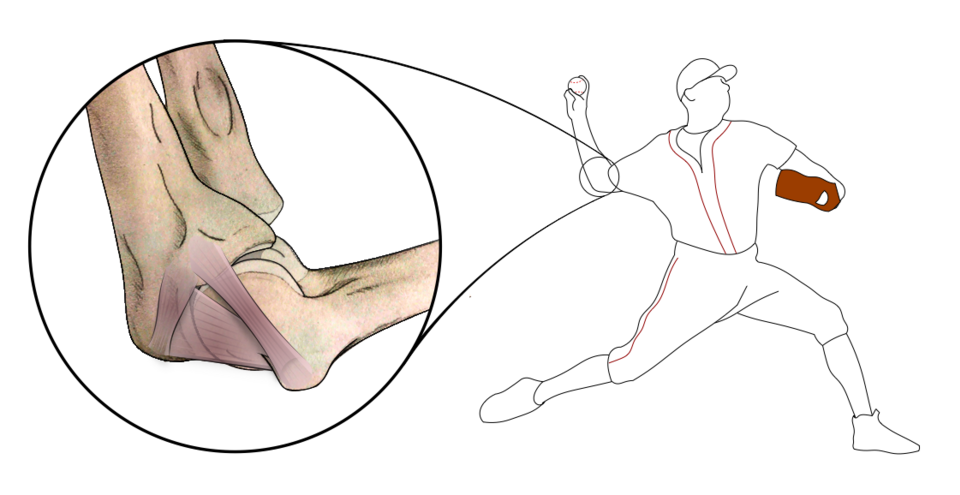
The ulnar collateral ligament (UCL) is a thick band of tissue on the inner side of the elbow. It connects the upper arm bone to the forearm and is the main restraint against the stress that throwing places on the elbow.
How is the UCL injured?
Most UCL injuries develop gradually. Each hard throw loads the ligament close to its limit, and over many seasons it can stretch, fray and eventually tear. Baseball pitchers are affected most often, but the injury also occurs in javelin throwers, quarterbacks, tennis and volleyball players and gymnasts. Less often the ligament tears suddenly, in a fall or an elbow dislocation.
What are the symptoms?
- Pain on the inner side of the elbow during or after throwing
- A drop in velocity or loss of control
- A pop on a single throw, followed by an inability to keep throwing
- Numbness or tingling in the ring and small fingers, from irritation of the nearby ulnar nerve
How is it diagnosed?
Dr. Reddy examines the inner elbow for tenderness and tests the ligament under stress. X-rays look for bone spurs, small fractures and loose fragments. An MRI, sometimes with contrast dye in the joint, shows whether the ligament is sprained, partly torn or completely torn. Ultrasound can show the ligament and the ulnar nerve as the elbow moves.
Can a UCL injury be treated without surgery?
Yes, in many cases. Sprains and many partial tears are treated with a period of rest from throwing, followed by physical therapy for the shoulder, core and forearm and a structured return-to-throwing program. Throwing mechanics and workload are reviewed. PRP injections are sometimes used for partial tears; the evidence for them is limited and mixed. People who do not throw competitively often do well without surgery even with a complete tear.
What is Tommy John surgery?
Tommy John surgery is the common name for UCL reconstruction, named for the major league pitcher who first had the operation in 1974. The torn ligament is replaced with a tendon graft, usually a small tendon from the forearm or a hamstring tendon, which is passed through tunnels in the bones on either side of the elbow. In selected patients with a tear at one end of otherwise healthy ligament, the UCL can be repaired and reinforced instead of reconstructed.
Who needs it?
Reconstruction is generally recommended for throwing athletes with a complete tear who want to return to competition, and for those with partial tears that have not responded to a full course of rehabilitation.
What is recovery like?
The elbow is protected in a brace at first, with motion restored over the early weeks. Strengthening follows, and a throwing program usually begins around four to six months after surgery. Pitchers typically need twelve to eighteen months to return to competition; position players often return sooner.
This page is general information, not medical advice. Recovery times are typical ranges and vary from person to person.
ELBOW CONDITIONS
All elbow topics
UCL (Tommy John) Injuries
Distal Biceps Tendon Tears
Tennis Elbow (Lateral Epicondylitis)
Golfer’s Elbow (Medial Epicondylitis)
Ulnar Nerve Problems
Elbow Fractures

AT A GLANCE
Manoj P. Reddy, MD
- Board-certified orthopaedic surgeon, fellowship-trained in sports medicine and shoulder surgery at the Rothman Orthopaedic Institute
- Orthopaedic surgery residency at the University of Chicago
- Specializes in arthroscopic, reconstructive and joint replacement surgery of the shoulder, knee and elbow
- Assistant team physician for the Philadelphia 76ers, Eagles and Phillies during fellowship; covers Rowlett, Garland and Naaman Forest high schools
- Author of 27 peer-reviewed publications in sports medicine
- Living Magazine Top Doctor, 2024

