

Meniscus Tears care in North Texas. Dr. Manoj P. Reddy evaluates and treats this condition at his Dallas, Rockwall and Garland offices.
What is the meniscus?
Each knee has two menisci, C-shaped pads of tough cartilage that sit between the thigh bone and the shin bone, one on the inner side and one on the outer.
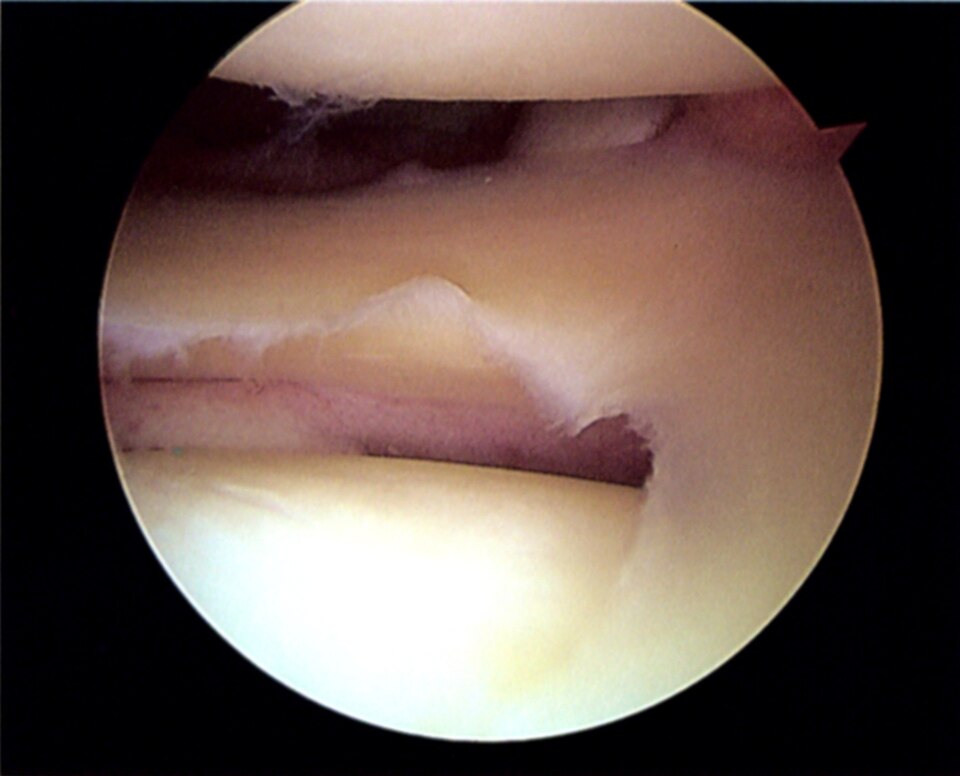
How does the meniscus work?
The menisci spread load across the joint, absorb shock and add stability. Losing meniscus tissue increases the pressure on the joint surface and raises the long-term risk of arthritis, which is why preserving the meniscus matters.
How is the meniscus injured?
In younger patients, tears usually follow a twisting injury on a bent, weight-bearing knee, often during sports and sometimes together with an ACL tear. In older patients the tissue weakens with age, and a tear can occur with a minor movement such as squatting.
What are the symptoms?
- Pain along the inner or outer joint line
- Swelling that develops over a day or two
- Catching, clicking or locking
- Difficulty fully straightening or deeply bending the knee
How is a meniscus tear diagnosed?
Diagnosis is based on the history, an examination of the joint line, and imaging. X-rays assess alignment and arthritis. An MRI shows the location and pattern of the tear, which largely determine whether it can be repaired.
How is a meniscus tear treated?
Not every tear needs surgery. Many degenerative tears improve with therapy, activity changes and sometimes an injection. Surgery is considered for tears that cause mechanical symptoms such as locking, for repairable tears in younger patients, and when symptoms persist.
- Meniscus repair: the torn edges are sutured together arthroscopically so the tissue can heal. This is preferred whenever the tear pattern and blood supply allow.
- Partial meniscectomy: only the unstable torn fragment is trimmed, keeping as much healthy meniscus as possible.
- Meniscus transplant: for selected younger patients who have lost a meniscus and have ongoing pain, donor tissue can be implanted.
What is recovery like?
After a partial meniscectomy most people walk right away and return to activity within a few weeks. A repair needs protection while it heals, usually with a brace and limited weight bearing for four to six weeks, and a return to sport in about four to six months.
This page is general information, not medical advice. Recovery times are typical ranges and vary from person to person.

AT A GLANCE
Manoj P. Reddy, MD
- Board-certified orthopaedic surgeon, fellowship-trained in sports medicine and shoulder surgery at the Rothman Orthopaedic Institute
- Orthopaedic surgery residency at the University of Chicago
- Specializes in arthroscopic, reconstructive and joint replacement surgery of the shoulder, knee and elbow
- Assistant team physician for the Philadelphia 76ers, Eagles and Phillies during fellowship; covers Rowlett, Garland and Naaman Forest high schools
- Author of 27 peer-reviewed publications in sports medicine
- Living Magazine Top Doctor, 2024

