
Distal Biceps Tendon Tears care in North Texas. Dr. Manoj P. Reddy evaluates and treats this condition at his Dallas, Rockwall and Garland offices.
What is the distal biceps tendon?
The biceps muscle attaches to the forearm, just below the elbow, through a single strong tendon. It bends the elbow and, more importantly, powers turning the palm up, the motion used to turn a screwdriver or a doorknob.
How does it tear?
The tendon usually tears when the elbow is forced straight against a contracting biceps, such as catching a heavy object that is falling or losing control of a heavy lift. It is most common in men between 40 and 60. The tendon nearly always pulls completely off the bone.
What are the symptoms?
- A sudden pop and sharp pain at the front of the elbow
- Bruising in the elbow crease and forearm over the next few days
- A change in the shape of the biceps, which may bunch up toward the shoulder
- Weakness bending the elbow and, especially, turning the palm up
How is it diagnosed?
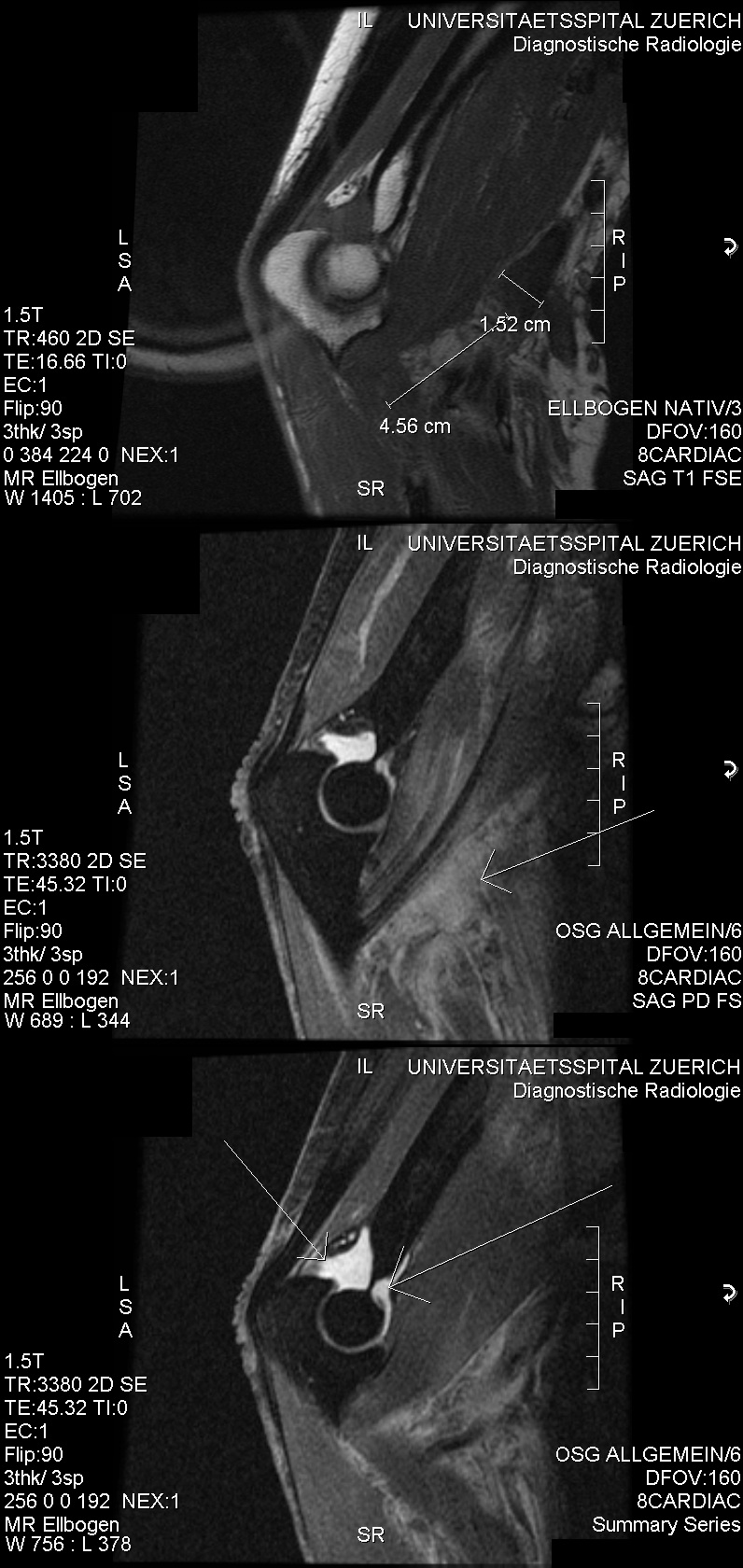
The diagnosis is often clear from the history and examination, including a test in which the examiner tries to hook a finger under the tendon. An MRI or ultrasound confirms the tear and shows whether it is partial or complete and how far the tendon has pulled back.
Can it be treated without surgery?
The tendon will not reattach on its own. Without repair, most people keep reasonable elbow bending strength because other muscles help, but they lose a substantial part of their strength and endurance turning the palm up. Non-operative care can be a reasonable choice for older or less active patients, or when the tear is partial.
What does repair involve?
Through a small incision at the front of the elbow, the tendon is retrieved and reattached to its spot on the forearm bone with an anchor or a small button. Repair is easiest and most reliable when done within the first two to three weeks, before the tendon shortens and scars. Chronic tears may need a tendon graft.
What is recovery like?
The elbow is protected in a splint or brace for a short period, then motion is restored over several weeks. Light strengthening starts at around six to eight weeks, and heavy lifting is usually allowed at four to six months.
This page is general information, not medical advice. Recovery times are typical ranges and vary from person to person.
ELBOW CONDITIONS
All elbow topics
UCL (Tommy John) Injuries
Distal Biceps Tendon Tears
Tennis Elbow (Lateral Epicondylitis)
Golfer’s Elbow (Medial Epicondylitis)
Ulnar Nerve Problems
Elbow Fractures

AT A GLANCE
Manoj P. Reddy, MD
- Board-certified orthopaedic surgeon, fellowship-trained in sports medicine and shoulder surgery at the Rothman Orthopaedic Institute
- Orthopaedic surgery residency at the University of Chicago
- Specializes in arthroscopic, reconstructive and joint replacement surgery of the shoulder, knee and elbow
- Assistant team physician for the Philadelphia 76ers, Eagles and Phillies during fellowship; covers Rowlett, Garland and Naaman Forest high schools
- Author of 27 peer-reviewed publications in sports medicine
- Living Magazine Top Doctor, 2024

