
Labral and SLAP Tears care in North Texas. Dr. Manoj P. Reddy evaluates and treats this condition at his Dallas, Rockwall and Garland offices.
What is the labrum?
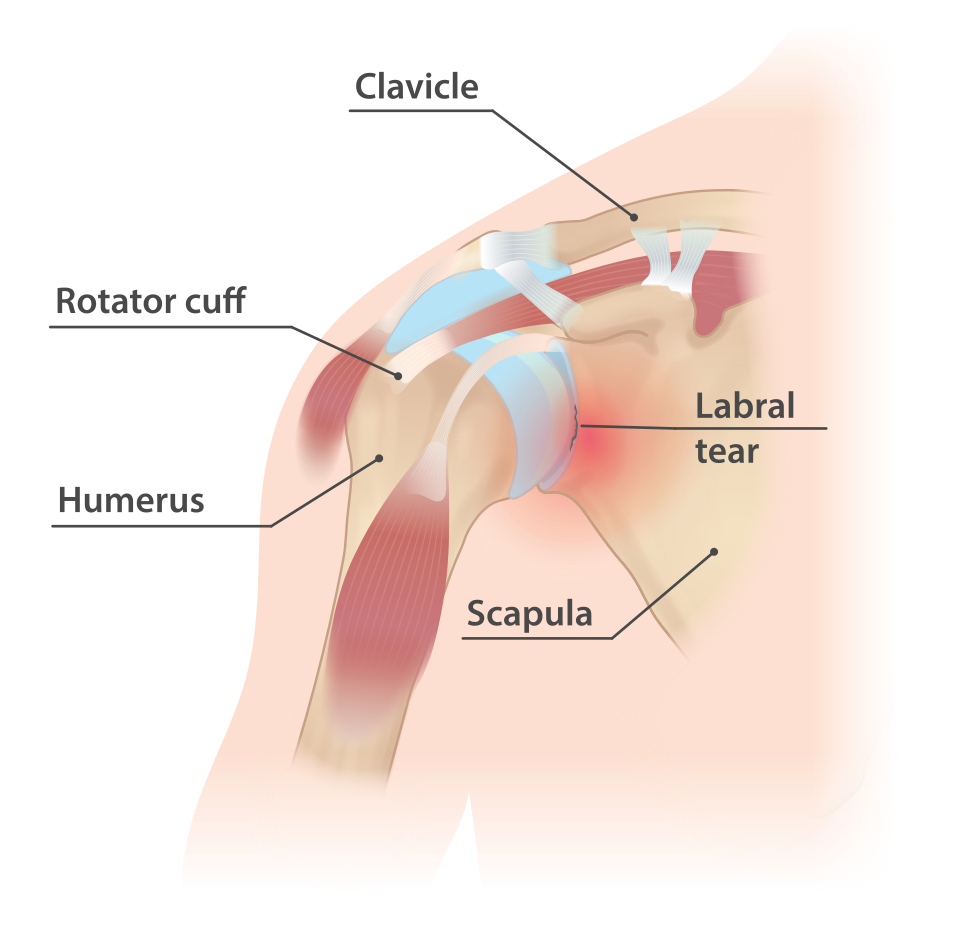
The labrum is a ring of cartilage attached to the rim of the shoulder socket. It deepens the socket, anchors the ligaments that keep the ball in place, and at the top serves as the attachment for the biceps tendon.
What types of labral tears are there?
- SLAP tears involve the top of the labrum, front to back, where the biceps tendon attaches.
- Anterior (Bankart) tears occur at the front and usually follow a dislocation.
- Posterior tears occur at the back and are seen in linemen, weightlifters and after backward-directed injuries.
What causes a labral tear?
A dislocation or subluxation, a fall onto an outstretched arm, a sudden pull on the arm, or repetitive overhead activity such as throwing. Some fraying of the labrum is also a normal finding with age.
What are the symptoms?
- Deep pain in the shoulder, often hard to pinpoint
- Catching, clicking or locking
- Pain with overhead or cross-body movements
- Loss of velocity or a dead-arm feeling in throwers
- A sense that the shoulder is loose or slipping
How is it diagnosed?
By examination and an MRI, often with dye injected into the joint (MR arthrogram) to outline the tear.
How are labral tears treated?
Many tears, particularly SLAP tears and age-related fraying, improve with rest from aggravating activity and physical therapy focused on the rotator cuff and shoulder blade.
Tears that cause ongoing pain or instability can be treated arthroscopically. The labrum is reattached to the socket with small anchors and stitches. In some patients, especially those over about 35 to 40 with a SLAP tear, a biceps tenodesis gives more predictable results than repair.
What is recovery like?
After a repair the arm is protected in a sling for about six weeks, with specific positions to avoid depending on where the tear was. Non-contact sports are usually around four months; contact, collision and throwing sports typically take six months or more.
This page is general information, not medical advice. Recovery times are typical ranges and vary from person to person.
AT A GLANCE
Manoj P. Reddy, MD
- Board-certified orthopaedic surgeon, fellowship-trained in sports medicine and shoulder surgery at the Rothman Orthopaedic Institute
- Orthopaedic surgery residency at the University of Chicago
- Specializes in arthroscopic, reconstructive and joint replacement surgery of the shoulder, knee and elbow
- Assistant team physician for the Philadelphia 76ers, Eagles and Phillies during fellowship; covers Rowlett, Garland and Naaman Forest high schools
- Author of 27 peer-reviewed publications in sports medicine
- Living Magazine Top Doctor, 2024

