

Rotator Cuff Tears care in North Texas. Dr. Manoj P. Reddy evaluates and treats this condition at his Dallas, Rockwall and Garland offices.
What is the rotator cuff?
The rotator cuff is a group of four muscles and their tendons that surround the ball of the shoulder. They keep the ball centered in the socket and power lifting and rotating the arm.
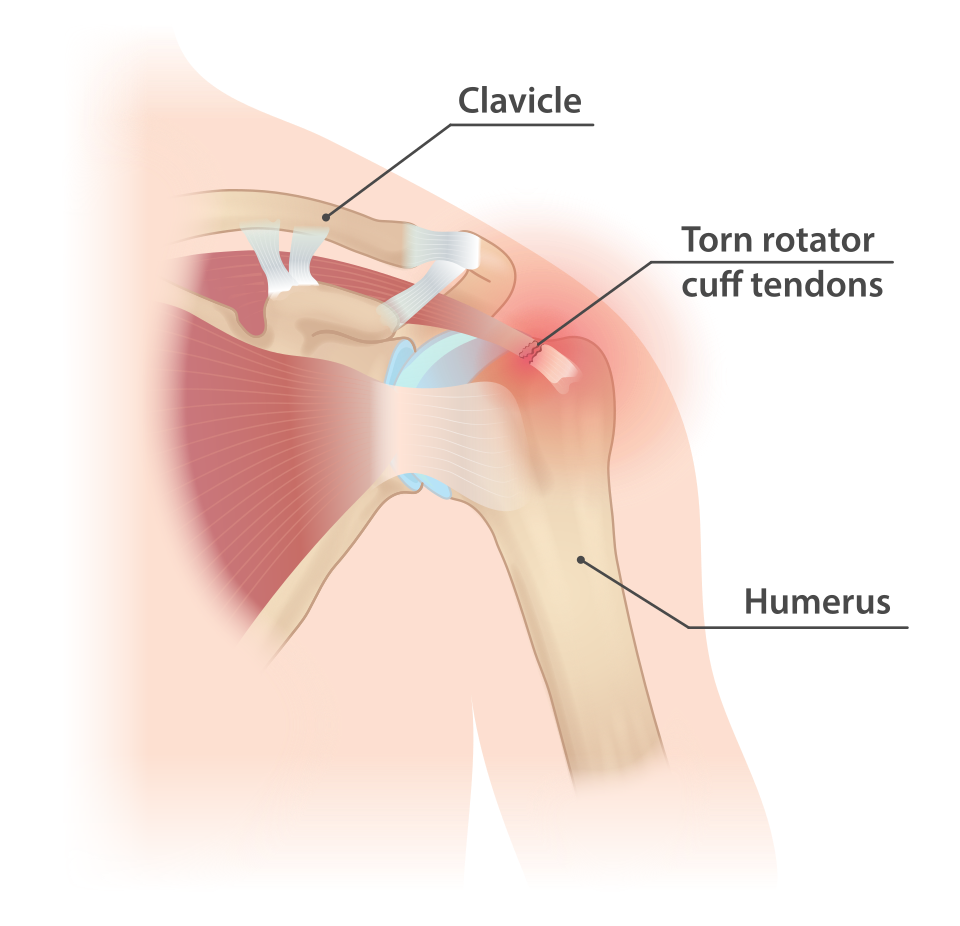
What causes a rotator cuff tear?
- Acute injury: a fall on an outstretched arm, a shoulder dislocation or lifting something heavy with a sudden jerk.
- Chronic overuse: repetitive overhead work or sport, such as throwing, tennis, swimming or painting.
- Degeneration: gradual wear of the tendon with age. Many tears after 50 develop this way, sometimes without a specific injury.
What are the symptoms?
- Pain on the outside of the shoulder and upper arm
- Pain at night, especially lying on the affected side
- Weakness lifting or rotating the arm
- Difficulty reaching overhead or behind the back
How is a tear diagnosed?
Dr. Reddy tests the strength of each tendon and looks for other causes of shoulder pain. X-rays show the bone and joint spacing. An MRI or ultrasound confirms the tear and shows its size, whether the tendon has retracted, and the quality of the muscle.
Can a rotator cuff tear be treated without surgery?
Often, yes. Many partial tears and degenerative tears respond to physical therapy, anti-inflammatory medication, activity changes and injections. The tear itself does not heal, but pain and function can improve substantially.
When is surgery recommended?
Repair is generally advised for acute full-thickness tears in active patients, for tears with significant weakness, and when symptoms continue despite a good trial of non-operative care. Large tears can enlarge and the muscle can deteriorate over time, which makes later repair harder.
What does rotator cuff repair involve?
The repair is done arthroscopically through small incisions. The tendon is brought back to its attachment on the bone and secured with suture anchors. Related problems, such as a damaged biceps tendon or a bone spur, are treated at the same time. When a tear cannot be repaired and arthritis has developed, a reverse shoulder replacement may be the better option.
What is recovery like?
The tendon heals to bone slowly, so the arm is protected in a sling for about four to six weeks. Therapy progresses from gentle motion to strengthening at around three months. Most people regain good function by six months and continue to improve for up to a year.
This page is general information, not medical advice. Recovery times are typical ranges and vary from person to person.

AT A GLANCE
Manoj P. Reddy, MD
- Board-certified orthopaedic surgeon, fellowship-trained in sports medicine and shoulder surgery at the Rothman Orthopaedic Institute
- Orthopaedic surgery residency at the University of Chicago
- Specializes in arthroscopic, reconstructive and joint replacement surgery of the shoulder, knee and elbow
- Assistant team physician for the Philadelphia 76ers, Eagles and Phillies during fellowship; covers Rowlett, Garland and Naaman Forest high schools
- Author of 27 peer-reviewed publications in sports medicine
- Living Magazine Top Doctor, 2024

