

Shoulder Fractures care in North Texas. Dr. Manoj P. Reddy evaluates and treats this condition at his Dallas, Rockwall and Garland offices.
What is a shoulder fracture?
Besides the collarbone, fractures around the shoulder most often involve the upper end of the arm bone (proximal humerus). Less commonly they involve the shoulder blade (scapula) or the socket (glenoid).
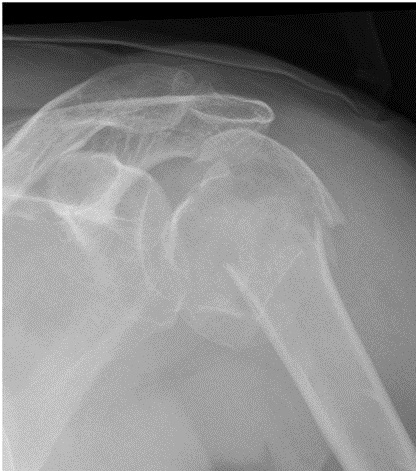
What causes a shoulder fracture?
In older adults, a simple fall from standing height is the usual cause, particularly when bone density is reduced. In younger patients these fractures follow higher-energy injuries such as sports collisions, cycling crashes and motor vehicle accidents.
What are the symptoms?
- Severe pain and inability to lift the arm
- Swelling and extensive bruising that may track down the arm and chest over several days
- Grinding with movement
- Numbness or tingling if a nerve is irritated
How is it diagnosed?
X-rays identify the fracture. A CT scan is often added to show how many pieces there are and how far they have moved, which guides treatment.
How are shoulder fractures treated?
Most proximal humerus fractures are not badly displaced and heal without surgery. The arm rests in a sling, and gentle guided motion starts early to limit stiffness. Bone healing takes about six to twelve weeks, and strength continues to return for many months.
Surgery is recommended when the pieces are significantly displaced or the joint surface is involved. Options include fixation with a plate and screws, or, for complex fractures in older patients with poorer bone, a reverse shoulder replacement.
What is recovery like?
Stiffness is the most common problem after any shoulder fracture, so physical therapy is an important part of recovery whether or not surgery is needed. Most patients regain function for daily activities, though some loss of overhead motion is common.
This page is general information, not medical advice. Recovery times are typical ranges and vary from person to person.
AT A GLANCE
Manoj P. Reddy, MD
- Board-certified orthopaedic surgeon, fellowship-trained in sports medicine and shoulder surgery at the Rothman Orthopaedic Institute
- Orthopaedic surgery residency at the University of Chicago
- Specializes in arthroscopic, reconstructive and joint replacement surgery of the shoulder, knee and elbow
- Assistant team physician for the Philadelphia 76ers, Eagles and Phillies during fellowship; covers Rowlett, Garland and Naaman Forest high schools
- Author of 27 peer-reviewed publications in sports medicine
- Living Magazine Top Doctor, 2024

