

Meniscus Root Repair in North Texas. Dr. Manoj P. Reddy offers this treatment at his Dallas, Rockwall and Garland offices.
What is the meniscus root?
Each meniscus is a C-shaped pad of cartilage anchored to the shin bone at its front and back ends. These anchor points are the roots. They hold the meniscus in position so that it can turn the load of body weight into tension around its rim, known as hoop stress, and spread it across the joint.
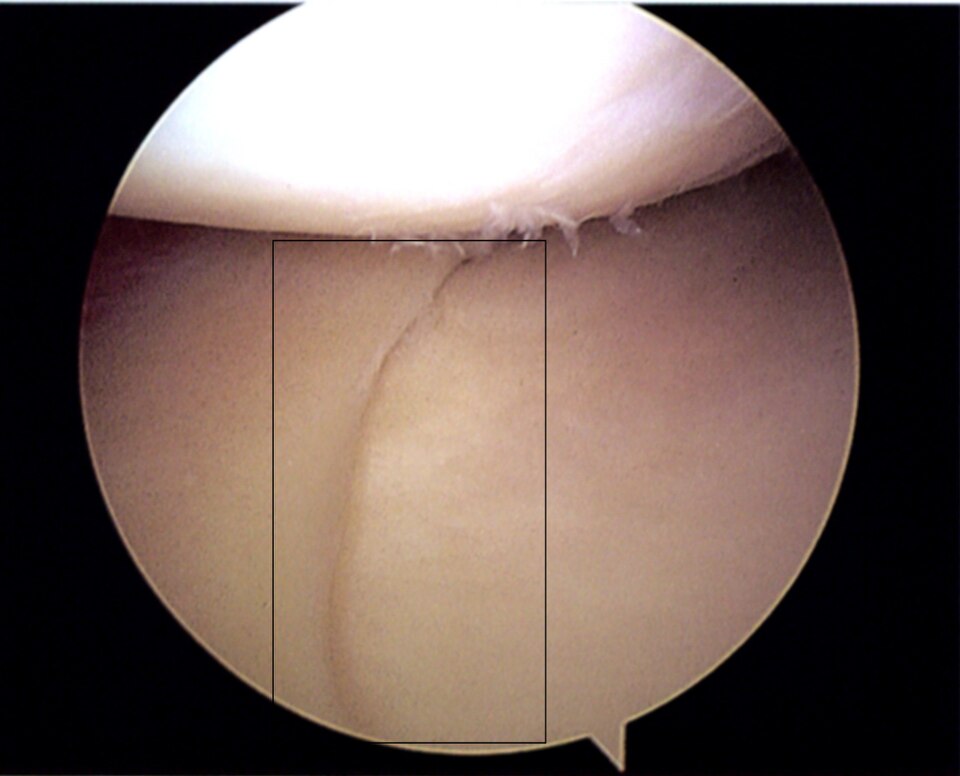
What is a root tear, and why does it matter?
A root tear is a tear at or within about a centimeter of the anchor point, most often at the back of the inner (medial) meniscus. When the root lets go, the meniscus is pushed out from between the bones and can no longer share load. Biomechanically, the knee behaves almost as if the entire meniscus had been removed, and arthritis can progress quickly.
What causes a root tear?
- Degenerative tears: the most common type, typically in people over 40, often from a simple squat or step. Many patients recall a pop at the back of the knee.
- Traumatic tears: in younger patients, usually alongside an ACL or multi-ligament injury, more often at the back of the outer (lateral) meniscus.
What are the symptoms?
- A pop followed by pain at the back of the knee
- Pain with deep bending and squatting
- Swelling and pain along the joint line
- Symptoms that do not settle as expected for a simple meniscus tear
How is it diagnosed?
By examination and an MRI, which shows the tear at the root and whether the meniscus has been pushed outward. Standing X-rays, including full-length alignment films, show how much arthritis is present and whether the leg is bow-legged.
Who is a candidate for root repair?
Repair is generally recommended when the cartilage is still in good condition, alignment is acceptable and the patient is active. When advanced arthritis is already present, repairing the root is unlikely to help, and treatment focuses on the arthritis instead. If the knee is significantly bow-legged, an osteotomy may be recommended with the repair.
How is the repair performed?
The procedure is arthroscopic. Strong sutures are passed through the torn root. A small tunnel is drilled through the shin bone to the exact point where the root attached, the sutures are pulled down through the tunnel so the root is seated against bone, and they are tied over a button or anchor on the front of the shin.
What is recovery like?
The root must heal to bone, so protection is strict early on. Weight bearing is limited for about six weeks, bending is restricted to 90 degrees, and deep squatting is avoided for at least four months. Physical therapy progresses from motion to strengthening. Most patients return to full activity at around five to six months.
Download the meniscus root repair protocol.
What are the risks?
Specific risks include the repair not healing or the meniscus remaining partly pushed out, and continued progression of arthritis. As with any operation, there are also general risks of infection, blood clots, stiffness, nerve or blood vessel injury and problems with anesthesia. These are uncommon, and steps are taken to lower them.
This page is general information, not medical advice. Recovery times are typical ranges and vary from person to person.
KNEE TREATMENTS
ACL and Ligament Surgery
ACL Reconstruction and Revision
PCL Reconstruction
MCL Reconstruction
Multi-Ligament Reconstruction
Meniscus Surgery
Meniscus Repair and Meniscectomy
Meniscus Root Repair
Meniscus Transplant
Cartilage and Realignment
Cartilage Restoration
MACI Cartilage Implantation
Osteochondral Allograft (OCA)
Knee Osteotomy
Kneecap Stabilization
Patellar Stabilization
MPFL Reconstruction
Tibial Tubercle Osteotomy
Other Knee Treatments
Knee Arthroscopy
Quadriceps and Patellar Tendon Repair
Partial Knee Replacement
Injections
AT A GLANCE
Manoj P. Reddy, MD
- Board-certified orthopaedic surgeon, fellowship-trained in sports medicine and shoulder surgery at the Rothman Orthopaedic Institute
- Orthopaedic surgery residency at the University of Chicago
- Specializes in arthroscopic, reconstructive and joint replacement surgery of the shoulder, knee and elbow
- Assistant team physician for the Philadelphia 76ers, Eagles and Phillies during fellowship; covers Rowlett, Garland and Naaman Forest high schools
- Author of 27 peer-reviewed publications in sports medicine
- Living Magazine Top Doctor, 2024

